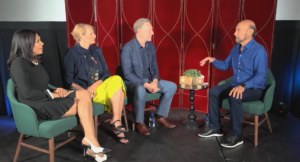
UNLV’s student newspaper put a number on the ambition behind THIRD Street. In February 2026, Scarlet & Gray reporter Andreea Cretu covered a 90-day fundraising sprint the team had set for itself: $1.5 million and 500 donors, raised fast enough to keep a three-story arts campus moving toward construction.
At the time the story ran, roughly $550,000 had come in from 78 private donors, with 33 days left on the clock. Cretu laid out what that money is meant to buy. The former Downtown Cinemas — eight auditoriums on South 3rd Street — becomes a 250-seat proscenium theatre, a 150-seat black box, a cabaret venue, and the dressing rooms and backstage space that live performance actually requires. Vegas City Opera, Vegas Theatre Company, the Las Vegas Sinfonietta and Laugh After Dark are the resident companies. Teller serves as honorary patron.
One hub instead of four
We need all of these companies to be in one central hub.
Ginger Land-van Buuren, Chief Operating Officer, THIRD Street
That is the whole thesis, stated plainly. Four organizations currently carry four sets of overhead — four leases, four box offices, four load-in problems — while competing for the same audience and the same donors. Put them under one roof and the duplicated cost turns back into programming. Land-van Buuren told Scarlet & Gray the point is incubation: giving small companies the shared infrastructure that lets them reach a level none of them could fund alone.
The fragmentation problem
Cretu’s reporting is strongest where it lets working artists describe the gap. A Vegas City Opera singer noted he could count on one hand the shows he has done here involving dancers — the number was two. Las Vegas Sinfonietta director Taras Krysa described the city’s music culture as fragmented, and traced it to youth rather than indifference: fifty years ago there were showrooms and almost no classical music, and the scene has grown fast enough that its parts have not yet learned each other’s names.
The artists know one another socially. They simply are not called into the same rooms to work. A shared campus is a scheduling and proximity fix as much as an architectural one.
The number behind it
Phase one requires $5 million before construction begins — the figure that funds the theatres, the building amenities, artist pay and the education programs. Land-van Buuren was candid with Scarlet & Gray about the difficulty: arts fundraising here leans almost entirely on private giving, and Las Vegas does not have the depth of philanthropic history that older cities draw on. Below the full $5 million, she said, the theatres do not get built and the programming does not reach the level the team is aiming for.
You can support the build, join the Founders Society, or inquire about space for your company’s next production.